[URBANFLOODS] A step closer to smart urban flood management solutions

How can cities recognise flood risk earlier, react faster and make better decisions in crisis situations?

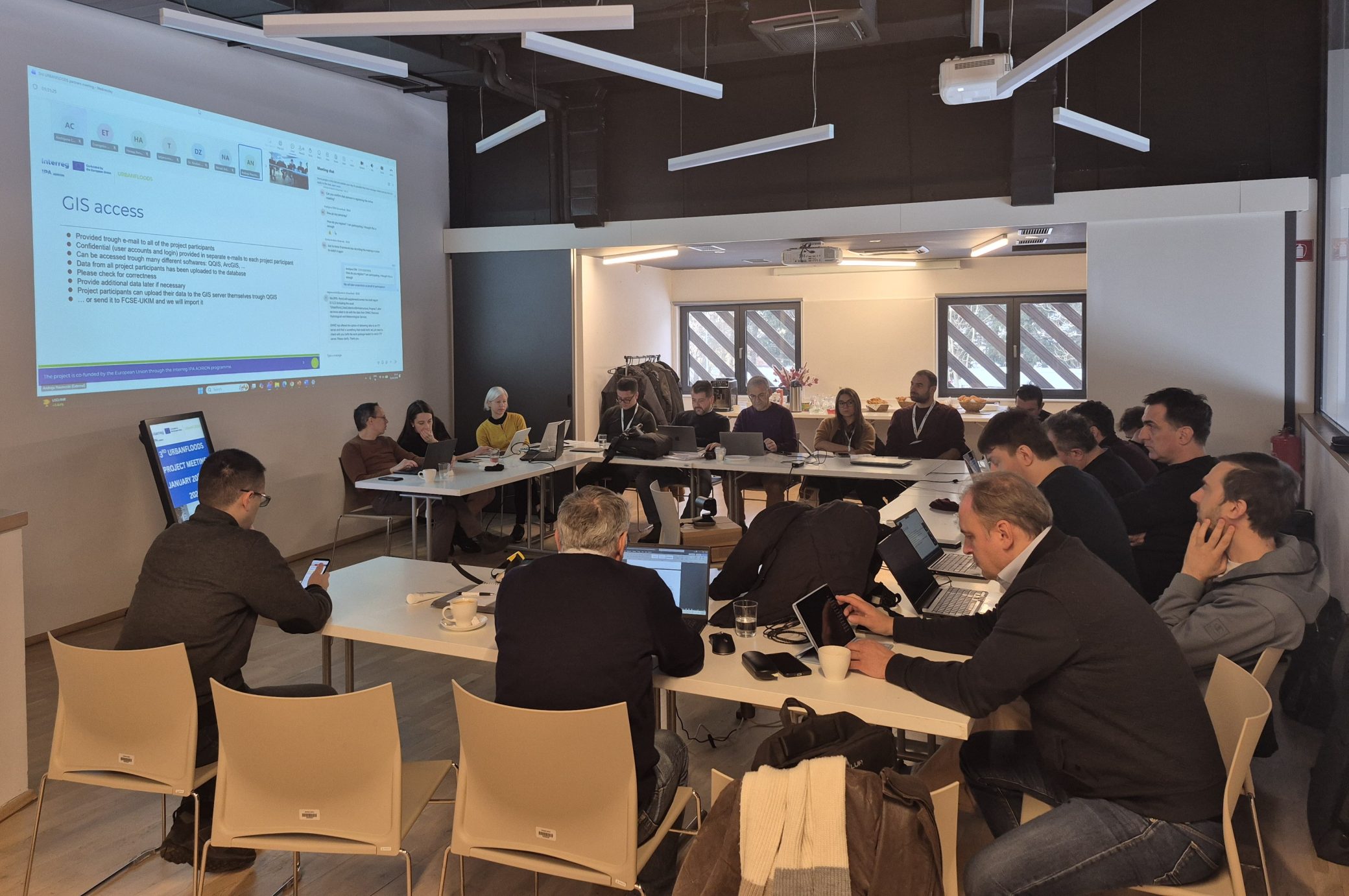
These were the key issues of the third transnational project meeting. URBANFLOODS, held on 21 and 22 January 2026 in Murska Sobota. The meeting was not just an exchange of information between partners, but a concrete step towards solutions to be used in the cities involved in the project.

From data to decisions

The main focus of the meeting was the progress in the development of an integrated decision support system, a tool that allows cities to assess urban flood risks and plan protection measures based on data.

Partners compared data collected at pilot sites, identified challenges in modelling flood scenarios, harmonised approaches so that solutions could be applied in different urban contexts. In other words, the project is at a stage where the technology is starting to get very concrete application in practice.

Particular emphasis was placed on the GIS database and data standardisation. Without common standards, solutions developed in one city are difficult to apply in another. That is why this step is crucial for the long-term value of the project. The aim is not an isolated solution, but a tool that can be adapted to the different cities in the region.

In addition to technical developments, the meeting confirmed the importance of knowledge exchange and long-term cooperation. In this context, the further development of the URBANFLOODS KNOWBASE platform, conceived as a common space for the exchange of experiences, data and good practices among cities and experts, was presented.

What's next?

The meeting clearly defined:

  • the next development steps of the DSS system,
  • deadlines for delivery of project results,
  • a plan for future activities and meetings.

A study visit to local good practice examples further helped partners to link theoretical solutions to real urban challenges.

Why is this important?

URBANFLOODS brings together partners from eight countries with a clear objective: increase urban flood resilience through smart, data-driven solutions. The third partnership meeting showed that the project goes beyond plans and strategies towards tools that cities will be able to use in their day-to-day risk management and climate change adaptation.

[EDUCATION] Become an IT Project Manager

The IT sector is one of the fastest growing industries, but the successful development of digital products depends not only on programming. An increasing role is played by IT project managers, people who connect people, technology and business goals.

That's why the entries are open. Bootcamp PM, an intensive educational programme aimed at women who want to start or develop a career in the IT sector through the field of project management. Education is carried out within the project SHIFT4IT It aims to empower young women to enter and work in the IT sector.

Who is Bootcamp PM for?

Bootcamp PM is intended for:

  • young women
  • aged 23 to 30 years
  • with education in social sciences and humanities

who want to enter the IT sector or be professionally oriented in it, but without the need for software pre-knowledge.

Employers in the IT sector are increasingly looking for profiles that, with a basic understanding of technology, have developed communication, organizational and analytical skills. IT project managers do not exclusively deal with technology, but look at the broader picture of product development with a focus on users, teams and business goals.

That is why the program is suitable for women who love working with people and in teams, who are interested in organizing, planning and managing projects, want to understand how digital products are created and are looking for a career in a dynamic and growing environment.

What does Bootcamp PM bring?

Bootcamp PM lasts 180 hours It is divided into four modules:

  1. the logic of product development in the IT sector
  2. UX/UI design
  3. agile methods
  4. Project Management

Through the program, students develop key competences needed to work in the IT sector, including:

  • Working with people and teams
  • Clear and effective communication
  • Organisation and planning
  • Analytical and Problem Thinking
  • basic understanding of business and technological processes

Connection to IT sector and certificate

In addition to knowledge and practical skills, the program allows students Direct connection with IT companies and potential employers through cooperation with industry and guest lectures.

Upon completion of the training, students have the opportunity to acquire internationally recognized certificate in the field of project management in line with Project Management Institute (PMI) standards, which represents added value in terms of employment and professional development.

Duration, location and applications

  • Duration of education: 16 March – 29 May 2026
  • Location: Centre of Technical Culture Rijeka, Školjić 6, Rijeka
  • Term: working days from 9.00 to 11.30 or 12.15 (depending on schedule)

Entries are open by 25 February 2026, followed by a selection procedure including:

  1. Documentary check
  2. Psychological testing (23-24 February)
  3. Orientation interview (2-3 March)

Participation in education is free, subject to mandatory registration here.

Planned EU Calls for Entrepreneurs in 2026

According to an indicative plan for the publication of calls; Under the 2021-2027 Competitiveness and Cohesion Programme, several calls are planned to be launched in 2026. focusing on micro, small and medium-sized enterprises with a focus on innovation, digital transformation, energy efficiency and business internationalisation;. Although the calls for grants are still in the planning phase, the 2026 competition plan provides an indicative insight into the direction and dynamics of future aid to entrepreneurs.

It is important to underline that this is an indicative timetable that serves as planning information. Call names, eligible applicants, conditions and deadlines may be changed until their official publication.

Innovation and development of new solutions

Among the planned calls for 2026, special emphasis is placed on Proof of Concept (PoC). The call is addressed to micro, small and medium-sized enterprises and research organisations that develop innovative products or processes and want to check their technical and market feasibility before commercialisation.

The call aims to strengthen R&D and innovation capacities and reduce the risk of investments in the later stages of development. Support is focused on the early stages of innovation, through activities such as prototyping, technical validation, market analysis, commercialization planning and intellectual property protection.

A total allocation of 5.3 million is envisaged. €3.7 million, of which €3.7 million €1.6 million for businesses and €1.6 million for businesses. EUR for research organisations. Individual projects are planned to receive between €26,500 and €60,000 in grants with a planned duration of 12 months.

According to the indicative plan, PoC is scheduled for the 1st and 4th quarters of 2026.

In the same innovation segment, a call is also planned Start-ups and spin-offs of young researchers, targeted at undertakings wishing to convert R&D results into market-sustainable products or services. The call aims to encourage the commercialisation of knowledge and strengthen research-based entrepreneurial activities.

According to the indicative plan, the total allocation of this call is 4.9 million. EUR and its publication is planned for Q2 2026.

Digital vouchers

Among the planned calls is also Digital voucher, intended for micro, small and medium-sized enterprises as an instrument of rapid and targeted support for business development.

Vouchers focus on financing specialised external services that can help entrepreneurs develop, innovate and strengthen competitiveness. Due to their simpler structure and shorter duration, they are often the first step in the realization of development ideas.

According to the indicative plan, the total allocation of this call is €3.9 million. EUR, and its publication is planned for the 2nd quarter of 2026.

Internationalisation, energy and business resilience

The indicative plan for the publication of the call for 2026 also includes a series of measures aimed at strengthening the competitiveness, resilience and sustainability of micro, small and medium-sized enterprises.

In the area internationalization, calls are planned to enable entrepreneurs to strengthen their presence in foreign markets, including the use of digital channels and tools to export products and services.

For undertakings planning investments in energy efficiency and sustainability, the indicative plan foresees a call focusing on: investments in energy storage and smart energy grids, with the aim of increasing energy stability and more efficient use of renewable energy sources. According to the plan, it is a call with a total allocation of 10 million. EUR, with the planned start of publication in Q1 2026.

The plan also includes calls aimed at Strengthening the resilience of SME business models, through process innovation and business organisation, in particular in the context of adapting to market, technological and energy challenges. This group also includes a call related to the introduction of sustainable and resilient systems and processes, with a planned release in the 2nd quarter of 2026 and a total allocation of 17.2 million. EUR.

In this context, a call is also planned. Second chance for SMEs, intended for micro, small and medium-sized enterprises that are in the phase of business recovery, restructuring or business adjustment. The aim of the call is to strengthen the financial and organisational stability of the company and to enable the continuation or adjustment of business activities in changed market conditions. According to the indicative plan, the total allocation is 11.3 million. EUR, and the call is scheduled to be launched in the 2nd quarter of 2026.

What does this plan mean for entrepreneurs?

The published indicative plan does not constitute an invitation to apply, but can serve as a Orientation for strategic planning. Based on this information you can:

  • define project ideas,
  • assess their own capacities and needs;
  • consider possible cooperation and partnerships;
  • monitor official announcements and consultations.

Our task is to continue to follow the announcement of the tender and to inform you in a timely manner about the current funding and support possibilities.

Supplier database of the Ministry of Economy: a new tool for visibility and connecting entrepreneurs

In conditions of increasing competition and open market, visibility and networking become as important as the product or service itself. For many entrepreneurs, especially micro, small and medium-sized entrepreneurs, the challenge is not only the quality of the offer, but also the arrival of potential partners, investors and larger systems. It is in this context that it is important to monitor the tools that can open up additional business opportunities.

One such tool is Supplier base developed by Ministry of Economy Republic of Croatia.

What is the supplier base?

Supplier base is free digital platform intended to present products and services of Croatian entrepreneurs to potential and existing investors in the Republic of Croatia, as well as foreign business partners.

The platform is part of the country's wider investment infrastructure and is linked to the national investment portal Invest Croatia, which serves as central contact point for investors interested in business and investment in Croatia.

Who is the base for?

The supplier database is intended for domestic entrepreneurs who want to present their products and services to potential and existing investors in the Republic of Croatia and foreign partners.

The purpose of the database is to facilitate the availability of information on domestic suppliers within investment projects and to support business internationalization activities.

What do entrepreneurs get by enrolling in the database?

Subscription to the supplier database opens an additional channel of visibility and connection. Entrepreneurs can make basic information about their business available to investors and partners who use the Invest Croatia platform as a source of information. In this way, entrepreneurs can be presented as potential suppliers within larger investment projects and supply chains, in accordance with the interests and needs of investors.

It is important to point out that the base is conceived as information and connectivity tool, not as a tender or funding scheme. It aims to facilitate the identification of domestic suppliers in the planning and implementation phase of investment projects.

How to enroll?

Registration in the supplier database is free and carried out through this links.

When enrolling, entrepreneurs enter basic information about the company, activities, products and services, which allows a clear and clear presentation to potential users of the database.

Why is this important for entrepreneurs?

For many entrepreneurs, especially those who operate outside large urban centres or do not have developed international contacts, such platforms can be an additional channel for visibility and informing potential partners about their offer.

The supplier base does not replace sales, marketing or personal access to partners, but it can be a useful first step to increase visibility. Engaging in the supplier base of the Ministry of Economy is a simple and free way for entrepreneurs to make their business profile more accessible to the wider business community. In combination with other development tools and activities, there can be additional support in strengthening competitiveness and long-term business development.