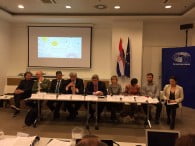
On Wednesday, 27 May 2015, Rijeka's candidacy for the title of European Capital of Culture was presented in front of the members of the selection committee.
The Rijeka candidacy in Zagreb was presented by the Mayor of Rijeka and the President of the Committee for the Preparation of the Rijeka Candidacy Vojko Obersnel, the Prefect Zlatko Komadina, the Mayor of Opatija Ivo Dujmić, the Head of the Department for Culture of the City of Rijeka and the Vice-President of the Committee for the Preparation of the Candidacy Ivan Šarar, the Advisor for International Cooperation in Culture of the City of Rijeka and the Head of the Preparation of the Candidacy Irena Kregar Šegota, the Vice-Rector of the University of Rijeka Snježana Prijić Samaržija, the architect Idis Turato as a member of the team for the development of the concept of candidacy, the director of the opera HNK Ivana pl. Zajca Marin Blažević as a member of the team for drafting the concept of candidacy and representative of independent culture Ivana Golob from the Centre for Industrial Heritage.
Primorje-Gorski Kotar County joined this project by signing a cooperation agreement, which agreed on activities on the preparation of documentation, the organization of cultural events and the preparation of projects for financing from EU funds.
The role of the Commission is to evaluate the applications of candidate cities, to agree on a list of cities entering the final selection phase, to propose one city for the award of the title of European Capital of Culture and the Melina Mercouri cash prize, to monitor the preparations of the named city and finally to submit a report on the basis of which the Commission will decide whether to award the Melina Mercouri cash prize to a particular city.
The commission consists of 12 members, 10 of whom are appointed by the European institutions – the European Parliament, the European Commission, the European Council and the Committee of the Regions, while two come from Croatia.
Throughout history, Europe has been the centre of extremely rich and diverse artistic development, with European cities playing a key role in shaping and disseminating culture. The European Capital of Culture is an initiative of the European Union that aims to highlight this richness and diversity, as well as the common cultural aspects of Europe, in order to help bring European peoples closer together and better understand each other.
In these circumstances, the overall objectives of the European Capital of Culture initiative are defined as follows: preserve and promote the diversity of cultures in Europe and highlight their common features, as well as increase citizens' sense of belonging to a common cultural space on the one hand, and foster cultural contribution to the long-term development of cities in line with their strategies and priorities on the other.
In line with these objectives, the city holding the title of European Capital of Culture will seek to improve the scope, diversity and European dimensions of its cultural offer, including transnational cooperation, through its activities; broaden access to and participation in culture; strengthen the capacity of its cultural sector and its links with other sectors, and raise its international reputation through culture.
The City of Rijeka, together with other Croatian cities, applied for the European Capital of Culture 2020 in April, thus officially applying for this prestigious title. The application documents, created after two years of intensive work on the preparation of the candidacy, provide an answer to the question of why Rijeka deserves and needs the title of European Capital of Culture.
Tender documentation is evaluated by the aforementioned Commission or the European Panel, and the oral defence of the tender documentation is underway, which takes place from 26 to 29 May. The results of the first round will be announced as early as Friday, May 29, and the city that will hold the title of European Capital of 2020 will be known in December 2015, i.e. after the end of the second round of the competition.
Two years ago, the City Council of the City of Rijeka adopted the Strategy for the Development of Culture of the City of Rijeka until 2020 as a basic precondition for the candidacy for the European Capital of Culture, after which an intensive period of preparation of the candidacy began.
Source: Fiuman.hr