Your business advantage starts with timely information

In today's business, priority is given to those who get the right information on time.

Whether you are just developing an idea, running a small team or doing business for years, the challenge remains the same – how to stay up-to-date with tenders, education and opportunities that can help you improve your business.

Many entrepreneurs seek useful information on a daily basis, but they often miss out on the sea of news and sources that are difficult to track. That's why we started newsletter with an overview of the most important information you need, in one place.

Our Newsletter Monthly Guide to Opportunities and Advice: open tenders, education in our organization or partner organization, information about projects that are useful to entrepreneurs, as well as an overview of services that can support business development. Everything is presented simply, clearly and without superfluous information, only what can be used in practice. It will help you plan and develop your business thanks to timely information that arrives when you need it most.

Why subscribe to the newsletter?

All in one place. No, no, no, no, no, no, no, no

✔ Competitions and Calls Relevant to Entrepreneurs

Overview of opportunities before the expiry of the time limits.

✔ Educations and events

Workshop announcements, lectures and meetings They provide knowledge, experience and networking opportunities.

✔ Opportunities through the projects we implement

As part of projects such as EDIH Adria, 3DOP, Europe Direct and others we share activities that are otherwise not widely available.

✔ Services

Notifications of Lease of space, coworking i the Virtual Office, 3D printing, scanning and modeling and other services for entrepreneurs.

✔ Entrepreneurial stories and inspiration

Interviews from our incubator, good practice examples and advice from real entrepreneurial experiences.

✔ Tools, guides and tips&tricks

Practical guidelines to improve business, from digitalisation to planning and organisation.

Your development begins with the right information. Subscribe to our newsletter.

Why is coworking more than a desk?

How does the environment shape productivity, ideas and business relationships?

Coworking is not just a shared office. Coworking is a space where ideas grow through conversation, support and random encounters that often grow into collaborations.

Why does the community make a difference and how can coworking help grow business?

Coworking is energy.

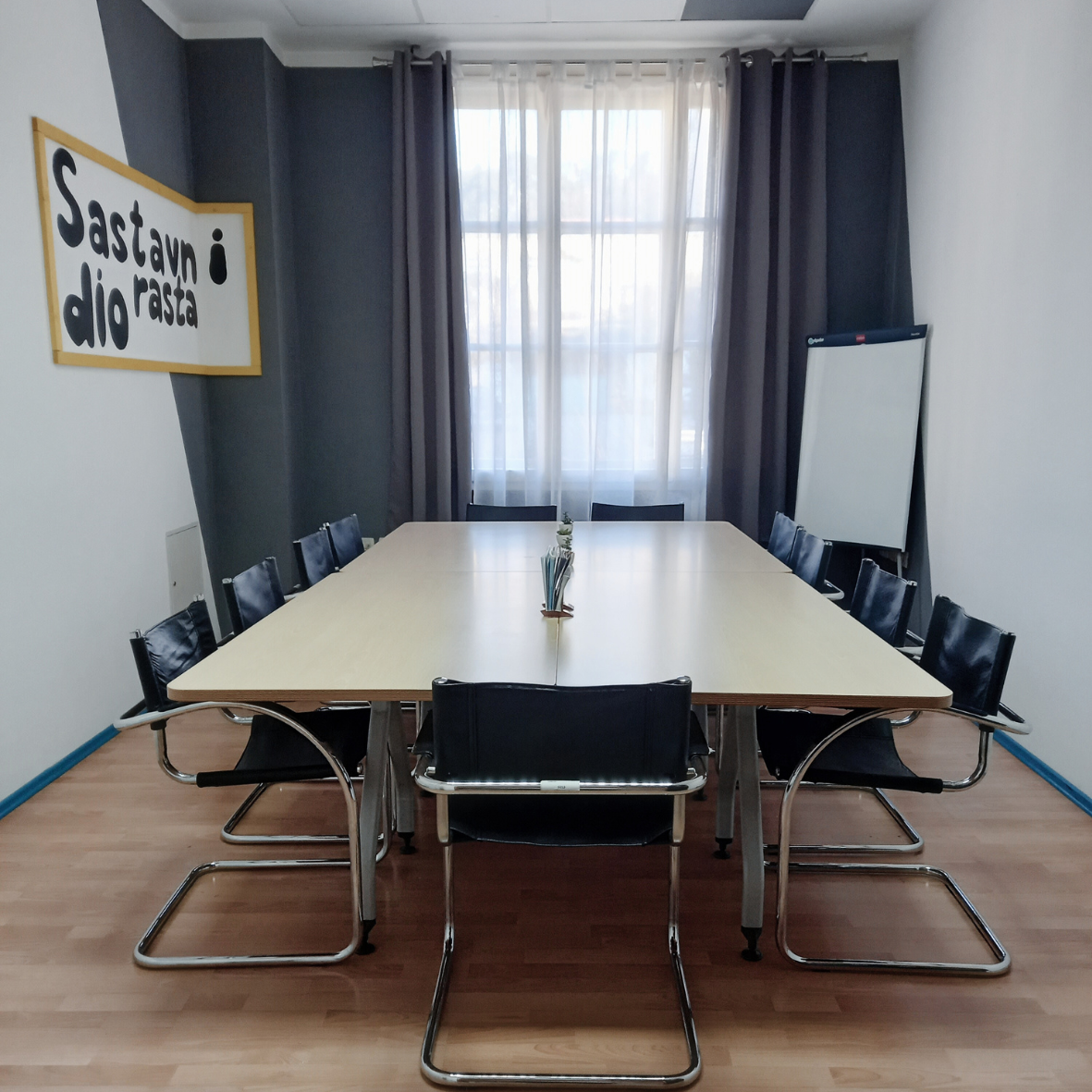
It is a place where ideas meet experience, where spontaneous conversation with coffee can grow into a new collaboration. U our coworking space, each table has its own story about the people who decided to grow together.

Coworking is a community that breathes together.

Working in a common space brings dynamics that are difficult to achieve by working independently. When one member gets stuck, one often finds someone with experience, a different view or simply a good word. Coworking communities often become places where partnerships are born, test ideas and develop mutual support.

In coworking, networking happens naturally.

The best collaborations rarely arise at formal meetings, most often they begin spontaneously. In the coworking space, members can meet a graphic designer, developer, designer or accountant and start the project together tomorrow. We meet freelancers, startups and small companies, each with a different experience, but the same goal: Grow and create.

In coworking, support is strengthened.

Being part of a community means having a circle of people who understand entrepreneurial challenges. Through education, mentoring and events that we organize, coworking members have the opportunity to learn, connect and tackle barriers together. An environment of mutual trust and knowledge sharing becomes a powerful incentive for the development of each individual.

Coworking is a workplace that drives.

Coworking is not just a physical space, it's a way of thinking. From an individual approach, we move towards joint growth. Inspiration and motivation spread naturally. The success of one member becomes a stimulus to the other. This is what makes the community a key driver of modern entrepreneurship. Choosing coworking is not just a workplace, but a community that understands, supports and encourages development.

An example of how the working environment can become a space of cooperation, inspiration and joint growth is Move Music, our user who started his or her journey in coworking, and today operates in the Incubation Program. Their growth shows that coworking can be more than a starting point, it can be a place from which entrepreneurial ideas grow into stable and successful business stories.


Join us in an interactive work environment at a location that meets all your business needs!

How to stay motivated when not everything goes according to plan?

Entrepreneurship often looks like a series of successes and new opportunities. But those who have really been through this time know that between every two victories there are months of doubts, attempts and moments when nothing seems to go according to plan.

That's when persistence is born. Not when everything goes smoothly, but when you decide to continue and when you do not know whether the effort will pay off.

What if the plan falls into the water?

All entrepreneurs experience moments in which everything seems to collapse: the project is delayed, the partner gives up, the sales are not going, and the costs are rising. In those moments, it's easiest to think that maybe this isn't for you.

Perseverance is not stubbornness. It's not blindly pushing forward without thinking. It is the ability to withstand, adapt and continue to learn even when there are no quick solutions.

Persistence is not ‘push at all costs’, but ‘adjust and go on’.

When the plan falls into the water, stop, but don't give up. Instead of looking for a new plan right away, first:

  • Take a breath and look at the bigger picture.
    Not everything failed, only one way failed. Success is not a series of perfect steps, but the ability to constantly try new ones.
  • Assess what really happened.
    Was the error in assessment, timing, resources, or communication? When you know the cause, it's easier to find a solution.
  • Reroute energy, not guilt.
    Instead of looking for the guilty in yourself or others, focus on what else you can do. Small actions restore a sense of control.
  • Learn and adapt.
    Each fall carries valuable information about what you need to change next time. If you learn a lesson, it wasn't a failure.

In practice, this means that you do not have to change the goal, but the way you come to it. Persistence often looks much more modest than it sounds.

It's a decision to show up and do your job even when no one's watching.
It is an e-mail that you send even though you have already received three refusals.
It's the day you stand up and say, I'm going again."

And it is in those days that what is later seen as success is built.

How to Stay Motivated in Difficult Moments?

Motivation is not constant. It comes and goes, but you can maintain it if you create a frame that keeps you and when the will yields.

  • Remind yourself of the ‘why’.
    Why are you even on your way? When doubts come back to that initial motive, it reminds you that what you're doing makes sense.
  • Set small, achievable goals.
    Big plans often seem too difficult. Small victories bring back a sense of progress and control.
  • Surround yourself with people who understand.
    Talking to other entrepreneurs is often worth more than advice. They know what a fight behind the scenes looks like.
  • Learn from failure, do not run away from it.
    Every mistake tells you something.. Analyze it without self-criticism. Mistakes are experience, not defeat.
  • Rest, but come back.
    Rest is not a sign of weakness, but a reset that gives you the strength to continue to be clearer and more focused.

Perseverance is the greatest victory.

Perseverance is not glamorous, but it is powerful. It does not guarantee that everything will succeed, but it guarantees that you will have the opportunity to try again and every time better.

So next time everything gets complicated, don’t ask yourself ‘why I’, but ‘what can I learn’. And move on. Because sometimes it's just Continuation of the biggest victory.

Small victories that lead to big results

When it comes to entrepreneurship, the most common ones are great successes as investments, expansion into new markets, expansion of the team.

The reality is that these moments happen rarely. What makes most of the entrepreneurial pathway are Small but important steps. Those daily victories that don't end up on the front page, but they mean everything.

The first client to trust you.
The first contract you've prepared for yourself.
The first month in which you did not have to invest your own savings.
The first day you managed to go home early because the job is finally breathing.

It may not look big on paper, but in practice it is a turning point.

Why are small victories so important?

Entrepreneurship is not a sprint but a marathon. You spend most of your time solving problems, making decisions and bearing responsibility for others. At such a pace, it is easy to get lost in "what else needs to be done" and forget about "what we have already achieved".

Small victories help you to:

  • you see progress and when it is slow,
  • Maintain motivation in uncertain phases.
  • and keep your perspective when plans don't go as expected.

Without them, the path would act as a series of obstacles without a goal. With them, each obstacle becomes part of a wider picture.

How to Recognize and Maintain Focus?

Many entrepreneurs tend to constantly "run further" and not stop. But recognizing small victories means Conscious evaluation of progress.

Here are some simple ways you can incorporate this into your everyday life:

  • Take notes of progress. Write down 2-3 things that have moved for the better once a month – a new query, a client recommendation, an improved process. Writing creates a sense of continuity.
  • Share your successes with the team. And the slightest acknowledgment such as "you solved this super", "this is a better version than last time" builds morality and a sense of community.
  • Set short-term goals. Instead of planning a year in advance, define what you want to accomplish this month. When you reach your goal, stop and admit it.
  • Compare yourself to the past, not to others. Comparison with competition often demotivates. Follow your own pace and your own shifts.

Small victories don't happen on stage.

Little victories rarely have spotlight lights. They happen by the way, between two meetings, in the silence of the office, while you close the laptop after a long day. These are the moments when you realize that the client has recommended you, that the team works more independently, that the challenges that you previously considered great are now solved more easily. No fanfare, no applause. Just a thought: "Well, it's going in the right direction."

And it is at this very moment that the real sense of success grows. One that does not arise in one day, but in the days when you decide not to give up.