SWOT analysis is a simple but powerful tool that helps answer the question: Does this idea make any sense at all?
What is SWOT analysis?
SWOT analysis is a method of strategic assessment that identifies Strengths, Weaknesses, Opportunities and Threats organisations, projects or business ideas in a realistic, structured and non-beautiful way.
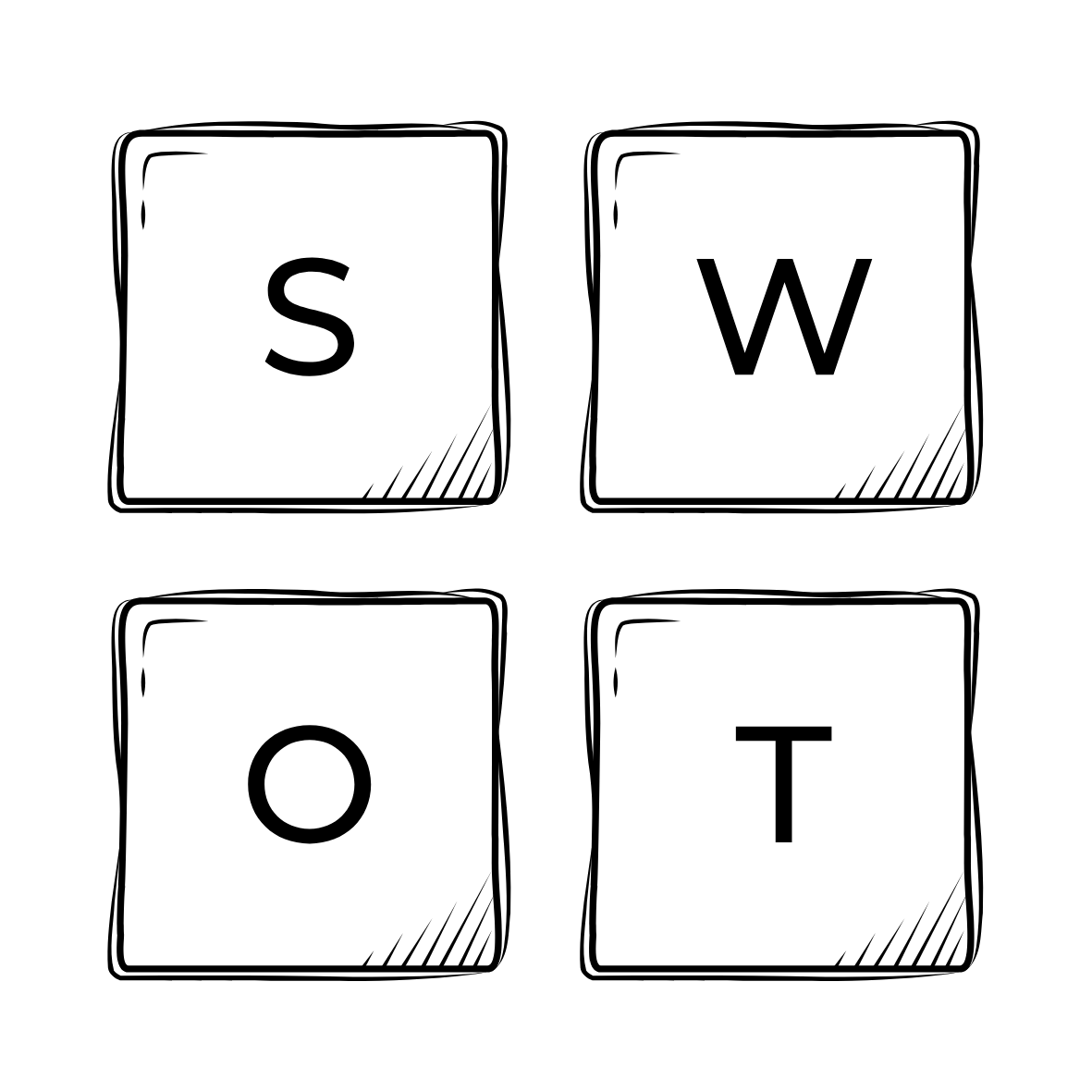
Strengths and weaknesses relate to internal factors, what the entrepreneur or future business already has or does not have (knowledge, resources, reputation, experience, processes).
Opportunities and threats relate to external factors, such as market trends, competition, legislation or technological changes.
Why is SWOT analysis important before starting a business?
SWOT is one of the most common tools used in strategic planning, business planning and investment decision assessment precisely because it helps in early identification of key success or risk factors;.
SWOT helps:
- to Realistically see their own strengths (knowledge, contacts, references, equipment),
- to Recognize the weaknesses which could slow down or stop the project (lack of capital, experience, time),
- to spot market opportunities (uncovered segments, new trends, local niches),
- to Recognize the Threats (strong competition, changes in regulations, dependence on one client).
Well done SWOT analysis does not give the final answer whether to start a business, but gives clear picture where you are strong, where you are vulnerable and what should be fixed.

How to make a SWOT analysis?
1. Determine clearly what is being analyzed
The first step is to define the subject of the analysis, i.e. whether it is a business idea, product/service or a specific project within the company. Unclearly defined focus leads to general and unusable conclusions.
2. Collect information about yourself
Strengths and weaknesses are based on internal resources and capabilities.
Powers represent everything that gives priority over others: knowledge, experience, technical skills, clients or a network of contacts, available resources or specific competences. Weaknesses refer to shortcomings that may hinder the implementation of an idea, such as lack of capital, expertise or staff, time or lack of sales and marketing capacity.
It's important to be honest. SWOT only makes sense if the data is based on a realistic estimate and not on the desired state.
3. Explore the market and the environment
Opportunities and threats come from the environment, from the market, from competition, legal regulations and the wider socio-economic context.
Opportunities may include niche markets, growing demand, new trends, available grants, subsidies or EU programmes. Threats include competition, regulatory changes, technological changes, market volatility, rising costs or dependence on a limited number of customers or suppliers.
This part of the analysis requires market research and information on the broader context of the activity. Here it is useful to rely on statistics and reports, not just the impression.
4. Organize brainstorming
It is recommended to develop SWOT analysis through structured brainstorming involving relevant stakeholders, such as team members, partners or external consultants. Such an approach allows for a broader view and reduces the risk of subjective assessment.
The debate is moderated and all proposals are systematically recorded. Upon completion of brainstorming, each identified item is critically reviewed, compared with others, and grouped to obtain a clear and applicable picture of the actual position.
5. Complete the SWOT matrix
When completing the SWOT matrix, it helps to ask specific questions.
Forces (S):
- What do we do better than others?
- What competencies do we already have?
- What resources do we already have?
Weaknesses (W):
- What are we missing?
- Where are we slower, more expensive or less organized than the competition?
- In which situations do we most often face difficulties?
Opportunities (M):
- What trends in our industry can be exploited?
- Are there market segments that are insufficiently covered?
- What incentives or support programs can we use?
Threats (T):
- Who are our real competitors and why are they stronger?
- What could the change of regulations, technology or customer habits turn against us?
- Are there any risks of dependence on a single customer or supplier?
The result is a clear picture that clearly shows where the idea is strong and where it is vulnerable.
What happens after the SWOT analysis?
SWOT analysis is not an end in itself. Used as starting point for decision-making It makes sense if its results are used in further planning. On the basis of the obtained insights, it is possible to:
- adapt the business model,
- redefine the scope of operations;
- decide on the pace of market entry,
- assess the need for additional knowledge, partners or funding.
Sometimes the result of a SWOT analysis can also be a decision to further elaborate or delay the idea, which is also a valuable outcome.
The most common errors in making SWOT analysis
In practice, SWOT analysis often comes down to formality. The most common mistakes include:
- too general claims without specific data;
- mixing internal and external factors,
- Excessive optimism that focuses only on strengths and opportunities;
- Lack of concrete conclusions.

That is why it is important that SWOT is based on real data, developed in a structured way (ideally with third-party moderation) and linked to the next steps, i.e. business plan, investment decision, choice of legal form.
Role of expert support
Although SWOT analysis on paper looks simple, in practice it often turns out that professional support is needed for a quality assessment of a business idea. Especially in the initial phase of entrepreneurship, it is useful to have an interlocutor who knows how to ask the right questions, help interpret the results and link the analysis to concrete business decisions.
Our advisory activities focus precisely on this approach. Through business consulting We provide support in analyzing business ideas, making analyses, studies and strategic documents that often include SWOT as an integral part and in defining further development steps, especially at an early stage of entrepreneurship entry.
For entrepreneurs, as well as for those who are just planning to become one, this means that they do not have to assess the potential of their idea by trial and error alone. Instead, through expertly guided analysis, we can give you a clearer picture of your own position and recommendations for the next steps. In this way, the first steps in entrepreneurship are adopted on the basis of structured analysis and professional support, which reduces risks and increases the likelihood of sustainable business development.