Blue Green City: 10th Online Meeting of Project Partners Held

On 27 July 2021, the partners of the Blue Green City project attended the 10th online meeting organised by the lead partner – Metropolis Nice Côte d’Azur. 

The meeting dealt with the preparation of draft regional Action Plans for the development and improvement of local/regional policy instruments and strategies in the implementation of the concepts of blue and green infrastructure, and the project partners individually presented the progress so far in defining the action guidelines with the aim of presenting the first draft Action Plans in September 2021.

For the smooth running of this activity, the partners had the support and expertise of an Italian partner – Regione Piemonte and an English partner – of the University of Greenwich.

The publication can also be found on the project’s official website: link.

Figure 1

Blue Green City: 4th Stakeholder Meeting in Rijeka

On 13 July 2021, RRA Porin, as a Blue Green City project partner, organised the 4th stakeholder meeting in Rijeka in the form of an event – a small conference of up to 20 people in line with Covid-19 restrictions, followed by a discussion. 

During the part of the conference, the representative of RRA Porin presented the Interreg Europe Blue Green City project and the detected problems in the green infrastructure of the Rijeka region, while from the City Department for Development, Urbanism, Ecology and Land Management, the Director of the Directorate for Development, Urbanism and Ecology presented the Green Infrastructure of the City of Rijeka, in order to encourage further discussion on how to improve the planning and implementation of green and blue infrastructure (BGI) in the City of Rijeka.

The discussion focused primarily on the improvement of urban blue and green infrastructure, in order to examine the possibilities of efficient planning and linking of green infrastructure at the strategic, spatial-planning, implementation and financial level of the city of Rijeka with the key issue of recognizing the importance of implementing the concept of green infrastructure in order to strengthen resilience and adaptation to climate change in urban areas and as a carrier of the identity of space that contributes to the development of the economy and society as a whole.

During the meeting, RRA Porin also conducted a survey through a short questionnaire to collect information from key stakeholders on the understanding of the concept of green and blue infrastructure and knowledge of relevant existing local documents for the development and implementation of BGI, as well as to examine the interest in encouraging cross-sectoral cooperation or initiatives to establish a working group that would include all stakeholders in the field of the establishment, planning and implementation of green urban infrastructure.

Prior to the fourth stakeholder meeting, RRA Porin organised the 3rd stakeholder meeting in January 2021 in the form of a one-on-one telephone call (in accordance with the measures and restrictions due to Covid-19 at the time) with representatives of the Department of Development, Urbanism, Ecology and Land Management of the City of Rijeka to discuss the recent Study of Green Infrastructure of the City of Rijeka, as an expert basis representing an integral form of viewing open spaces and the basis for the development of the Green Infrastructure Strategy of the City of Rijeka, with the aim of sustainable development of the city space that recognizes and gives importance to green and open spaces and their numerous functions (ecological, ​​social, economic, protective and urban morphological).


Blue Green City: 9th Online Meeting of Project Partners Held

On 29 June 2021, Blue Green City partners attended the ninth online meeting organised by the lead partner – Metropolis Nice Côte d’Azur. 

The meeting followed the previous meeting held on 25 May 2021, i.e. the presentation of best practices in the field of implementation of the GBI concept identified individually by the project partners, in accordance with the regional context and the real situation in the implementation of best practices.

In this direction, a part of the partners held again short presentations on recognized best practices in the field of the implementation of the concepts of blue and green infrastructures and at the partnership level discussed the possibilities of portability of the same or implementation individually at the regional level in accordance with the specificities of individual regions.

Figure 1

[TEMPUS] Online set of five cross-border projects: Strengthening cultural heritage through digitalisation

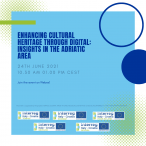
“Strengthening cultural heritage through digitalisation: Insights into the Adriatic area’ is the name of the online conference organised on 24 June by the participants of as many as five cross-border projects: TEMPUS, ECOMAP, MADE-IN-LAND, RECOLOR and REVIVAL financed from the EU programme INTERREG V A ITALY-CROATIA. On this occasion, project partners from both countries, Italy and Croatia, will promote the use of IT technologies in virtual visits to cultural institutions.

The event presents different approaches and methods focused on how the Adriatic regions can improve and valorise their cultural heritage thanks to information technology tools. Since 2001, the mass digitisation campaign has been promoting the creation of collections of European, national and thematic digital repositories belonging to EU galleries, libraries, archives and museums.

The conference will address digitalisation in various its forms, such as augmented and virtual reality, artificial intelligence and opportunities to improve the cultural sector through the use of digitalisation, sustainable and innovative technologies to improve marine and coastal areas, possibilities to use existing projects to strengthen the potential of cultural heritage, connecting tourist visitors and small businesses through smart solutions and new tools, and tools to revive and improve the heritage and landscape of the Adriatic region. A virtual tour of the forgotten heritage will also be organised and a virtual exhibition created to encourage new entrepreneurial ideas and a virtual experience called “Diocletian’s Dream” will be presented.

Although IT cannot replace the emotion of a direct visit to a cultural site, it can improve the visitor experience, support people who cannot travel, facilitate collaborative research of scientists working in different laboratories, and facilitate the preservation and restoration of ancient artifacts.

On the webinar, project participants will present the adopted technological solutions according to this Schedule, and you can join via these links 24 June 2021, 10.30 a.m.


The TEMPUS project – Temporary Applications as an Initial Action for the Improvement of Port (No) Material Heritage – brings together nine partners from Croatia and Italy with the aim of restoring abandoned urban port areas while respecting the cultural heritage and community customs of three pilot areas: Ravenna, Solin and Rivers.