As part of the ‘Optimisation of Production in 3DP – 3DoP’ project, we participated in the first partnership meeting in Brussels on 14-15 February, bringing together all 33 project partners.
At the meeting, the partners got to know the work of other partners better, but also their tasks on the project as well as the tasks of other partners. The project started on 1 January this year and lasts until the end of 2025, and at this meeting we started developing ideas for technical solutions and many other aspects of the project.
About the project
3D printing (3DP) has shown the potential to increase productivity, combine functionality and foster smart and green transitions. However, despite the clear advantages of 3DP in optimizing production processes, there are still significant bottlenecks that hinder the implementation and acceptance of 3DP.
3DoP aims to remove bottlenecks in competitive prices and quality levels compared to traditional production and unlock productive investments through:
Development of technical solutions in 4 targeted areas of application (‘Investment packages’).
Setting up an integrated framework of innovation and investment ecosystems.
Generations of sustainable investment chains of close-to-market and SME-led projects.
The implementation of 3DoP will have a major impact on EU production ecosystems through the sustainable optimisation of production processes. This will be done through the cooperation of the quadruple helix in the implementation of 3DP-based solutions that open up investments in regions and value chains.
The duration of the project is 3 years, from 1 January 2023 to 31/12/2025.
The project is funded by Interregional Innovation Investments (I3) and is one of the first such projects in Europe.
Porin participates in the development of technical solutions for electronics embedded in polymers and the exploitation and sustainability of investments.
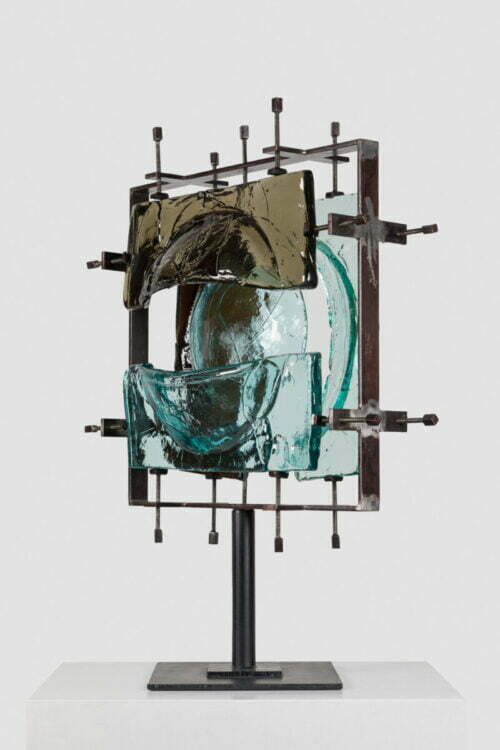
Museum of Modern and Contemporary Art, Thursday 16 February at 6 p.m., is a research and restoration project The Goldoni case. For the first time in more than four decades, the project presents Goldoni's 1973 sculpture Core (Forged Glass) to the public.
The presentation will include a lecture by a more conservator-restorer Duške Sekulić Ćiković, video interview with Livia Segus, Goldoni's friend and glass collaborator, and the results of a complete 3D scan of the sculpture. The interview was created in cooperation with the Academy of Fine Arts in Venice, and the 3D scanning project in cooperation with the Rijeka Development Agency Porin. With this presentation, MMSU marks the 40th anniversary of the premature departure of the artist Raoul Goldoni.
The sculpture and video interview will be available to the public the next day, on Friday, February 17, from 10 a.m. to 3 p.m., with the possibility of an expert presentation upon announcement.
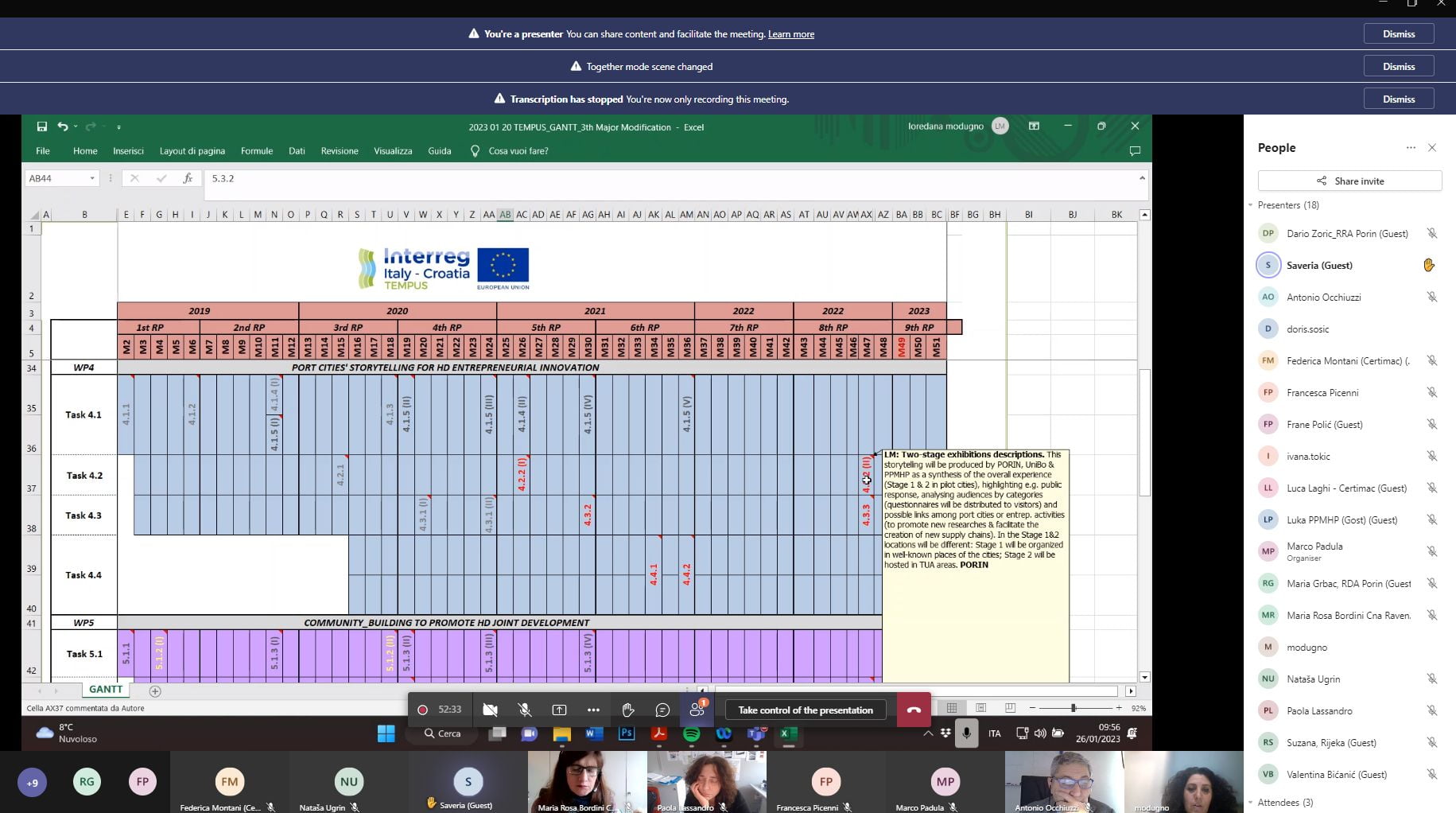
On 26 January 2023, the 7th online partnership meeting of the TEMPUS project was held. The project is co-financed by the Interreg VA Italy-Croatia Programme from the European Regional Development Fund.
The project partners discussed the activities to be completed by the end of the project as it lasts until 31 March 2022. Each partner, the holder of each work package, presented the upcoming project activities.
Representatives of the Rijeka Development Agency Porin d.o.o. presented the 4th work package and the remaining activities for completion. These activities concern the organisation of two exhibitions in the pilot cities of Ravenna and Solin; complete the process of launching a public call for ideas related to port heritage in Ravenna and Solin; based on the first two exhibitions, organize a third virtual exhibition that will be placed on the TEMPUS Portal; complete entrepreneurial ecosystem strategies in pilots Rijeka, Ravenna and Solin; develop a guide for developing an entrepreneurial ecosystem strategy; prepare a report on capacity building per pilot city; organise five meetings of Perspective Forums in pilot cities; develop a guide for the establishment of local management groups to monitor the situation after the end of the project and the appointment of such groups.
The TEMPUS project aims to regenerate abandoned urban port areas, respecting cultural heritage and community customs. In this sense, TEMPUS implements an integrated set of temporary use activities (TUA), focused on the idea of city ports as a mixed tradition, history, activities, architecture and culture. The activities of the project pass through the past and present of the port of Rijeka, highlighting the tangible and intangible heritage that wants to be highlighted by entrepreneurial ideas based on innovative solutions for improving a certain aspect of services or products for additional development in the area of the port of Rijeka.
On December 16, 2022, the fourth in a row was held at the Torpedo Production Park. Torpedo Days Meeting organized by the Rijeka Development Agency Porin d.o.o., EUROPE DIRECT Rijeka and the City of Rijeka, Department of Entrepreneurship.
TORPEDO DAYS is an event aimed at promoting new technologies and connecting different industries and academic sectors with new technologies. Torpedo days 04 brought together representatives of the public and private sectors to share their thoughts on the topic Transition pathway to digital and green in view of the needs and possibilities of development through the use of new technologies.
The event opened Ana Jerković, Coordinator of Europe Direct Rijeka and host of this event. She pointed out that the European Commission had published a new growth strategy at the end of 2019. The European Green Deal with a view to implementing the United Nations 2030 Agenda and transitioning towards a modern, greenhouse gas-free society. She stressed that the European Commission is committed to building A Europe fit for the digital age through the Technical Support Instrument, which helps Member States implement reforms to unlock the potential of digital growth and introduce innovative solutions for businesses and citizens, as well as to improve the availability and efficiency of public services. Finally, she stated that it is ideal that the green and digital transitions are mutually supportive, so that digital solutions stemming from the digital transition facilitate processes in the green transition, which is also the aim to present at today's event.
He greeted the assembled Dario Zoric, Director of the Rijeka Development Agency Porin d.o.o. who thanked all those present for their arrival and pointed out that he was particularly pleased that he was always looking for a place more for this event. On behalf of the City of Rijeka, the gathered greeted Vlasta Linić, Director of the Directorate for the Protection and Preservation of Cultural Property, who expressed her satisfaction with the unity of entrepreneurship and culture and pointed out that she looks forward to future cooperation following the new financial perspective of the European Union.
After the welcome speeches, a presentation of the project followed. Springback Ringside by Edwin Liveric, Director of HKD in Sušak. He revealed to the interested audience how the idea of documenting dance art into virtual reality came about. He pointed out that the main goal of the project is to bring performances to places that do not have the opportunity to physically show performances such as mountain and island areas. He also pointed out that they do not want to document the performances to be viewed at home, but to come to the show and share the experience because virtual reality will never replace the experience that the viewer has when he is present at the live performance. A little more about the technology itself and the way of recording and the experience of watching performances explained Igor Crnković, Director of Pilot Media, an associate who facilitated the realisation of the very idea of transferring transformative art into virtual reality. Finally, all interested parties were invited to experience a short play which resulted in a significant interest of those present.
Nenad Antolović, Member of the Board of Smart Ri, presented Urban Laboratory A smart cities project which, with the help of IT, aims to address the challenges facing the city. The project encourages cooperation between entrepreneurs and research and knowledge-dissemination organisations on research and development projects. Project partners will develop as many as 36 innovative smart city technology products and services with significant market potential. Products will be developed to the level of readiness for commercialization in the format of pilot projects and implemented in Rijeka, thus contributing to the development of Rijeka as a smart city. He emphasized that the Urban Laboratory is a physical space, a series of offline and online events, but also a platform where fellow citizens can find out everything you are interested in about the project and get informed about ways to get involved in the project. Also, to have the opportunity to try all those products and services that are intended for them, download some of the applications and evaluate them. Finally, he briefly presented the projects being implemented (SmartCity ENERGY&ENVIRONMENT, MODESTY, SURINMO, 4DII, CONNECTED TRAFFIC and LIVING) and invited us to visit the official website for more information, which presents in detail Smart Cities Competence Centre.
The topic of the smart city was followed by Ivan Jokić, electrical engineer/leader who presented Exevio d.o.o. and the project they are currently working on, A smart city through the eyes of citizensHe stressed that 3 applications are under development – Rilive, Roads and eTendering – and presented PLUGTURN – a smart sign, an electronic paper, which informs electric car drivers about the number and type of chargers on electric charging stations that work solar.
Duška Sekulić Ćiković, senior conservator-restorer at the Museum of Modern and Contemporary Art and Daniel Đuranović, the coordinator for the incubators of production activities and the technology laboratory of the Torpedo Production Park spoke about a new perspective in the protection of works of art. They presented the project. 3D Goldoni, cooperation between RRA Porin and MMSU, which was born following a problem they encountered, i.e. a broken glass pane. The solution was found in digitization and in a short time, and with the technology available at the Torpedo Production Park, they scanned the work of Raoula Goldonia. Daniel continued on the very process of 3D scanning in general and pointed out what they encountered when scanning Goldini's work. He presented options for further, a virtual museum?
Upon completion of the presentation of various digital and green projects, products and services, Vesna Bartolović Stančić, Head of the Regional Office of HBOR for the Littoral and Gorski kotar, informed the gathered about the possibility of financing entrepreneurs under the National Recovery and Resilience Plan (NRRP).
Finally, the participants visited the Torpedo Production Park where they had the opportunity to see industrial equipment for additive technology, i.e. 3D scanner, 3D printers and 3D modelling equipment, and a demonstration of the work of industrial equipment for additive technology was held.
Topic Transition pathway to digital and green It attracted many visitors to the Torpedo Production Park, so we would like to thank all the participants of the Torpedo Days 04 and look forward to the next events, including a joint gathering!


![[Case Goldoni] The Core Sculpture (Forged Glass) is presented to the public](https://porin.hr/wp-content/uploads/2025/06/7.-Goldoni-slika-1.jpg)
![[TEMPUS] SUSTAINABLE 7. PARTNER MEETING](https://porin.hr/wp-content/uploads/2021/09/layout_set_logo-260x68.jpg)
![[TORPEDO DAYS] The 4th edition of Torpedo days was digital and green!](https://porin.hr/wp-content/uploads/2022/12/IMG_7752-219x146.jpg)


